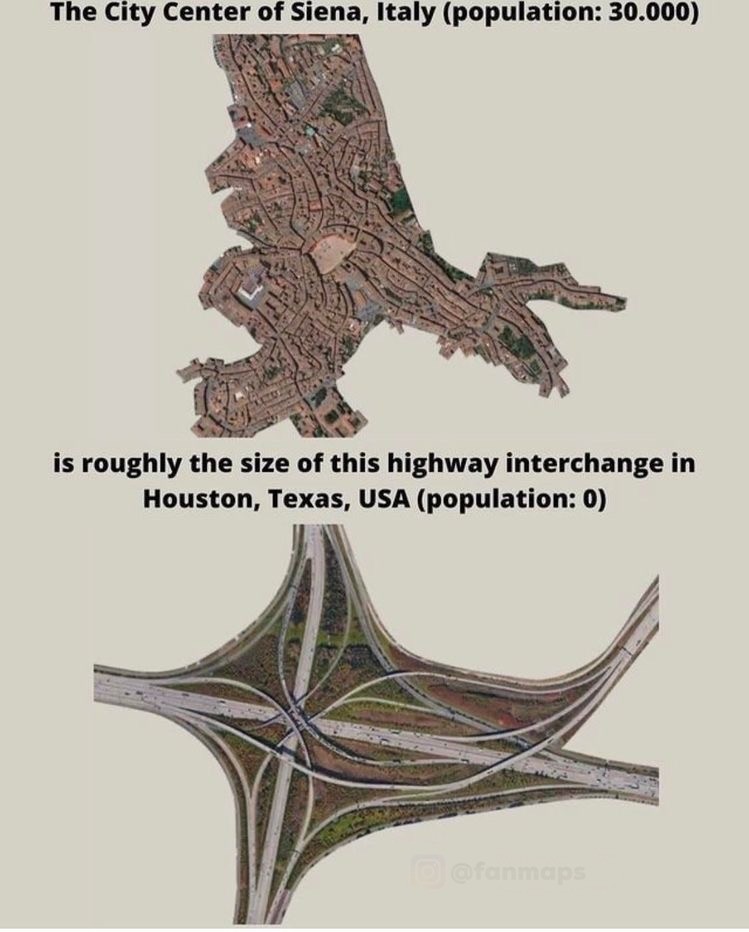
I just realised that cars in urban environments are a damn good example of the tragedy of the commons. Each car is
- a big but individual plus (fast transport) for its owner.
- a small but cumulative minus for everyone.
So if there’s just one or two cars it isn’t a big deal. But as more people get cars, those small minuses pile up, and fuck with everyone — including the car owners. Eventually reaching a point the “big plus” from car usage is overshadowed by all those “small minuses” from everyone else’s car usage.
This sort of situation cannot be solved by individual decisions; because, even in an environment where everyone would be better off without cars, not having a car is still worse than having one, because of that big plus. You need collective decision and action, to either lower that “big plus” (so there’s less reasons for the individual to use a car), or lowering that “small minus” (so your car ownership becomes less problematic for the others).
With that in mind, car infrastructure like the one in the second pic is completely the wrong way to go; it’s increasing both the big plus (cars become more viable) and the small minus (it’s space you can’t simply walk / bike through).
Remember, your one car is everyone else’s traffic.
Exactly. It’s everyone else’s traffic, pollution*, risk of death, increased distances, so goes on.
*electric cars alleviate the issue, but do not erase it. Pollution is not just what leaves the exhaust pipe, it’s everything, starting when the car is made.
deleted by creator
Didn’t I just read how Houston no longer has well-defined rush hours; its highways are congested all the time now.
“Useful.” Uh huh.
deleted by creator
Choked with cars, I reckon?
You’re missing the point.
The idea here is not to dick-fight countries. It’s to highlight the sheer amount of space that is wasted by infra-structure made for cars instead of people. The example would still work if both areas were controlled by the same government.
Is this clear now? Side note 2.3M / 53k ≃ 43, not 132.
deleted by creator
That explains the number. Point still stands, though; it isn’t just a ragebait comparison, it highlights the amount of space needed for car infrastructure. You argue the space in Huston would be otherwise wasted because the rest of the province is empty, but remember when you mentioned Rome in another comment? Well, Lazio isn’t exactly a desert. And you might not see something as egregious as this, as it’s split all around the city, but it’s still space being used for cars instead of something else.
Another thing this comparison highlights is the amount of resources that goes into car infrastructure. And that still applies even in an otherwise empty province.