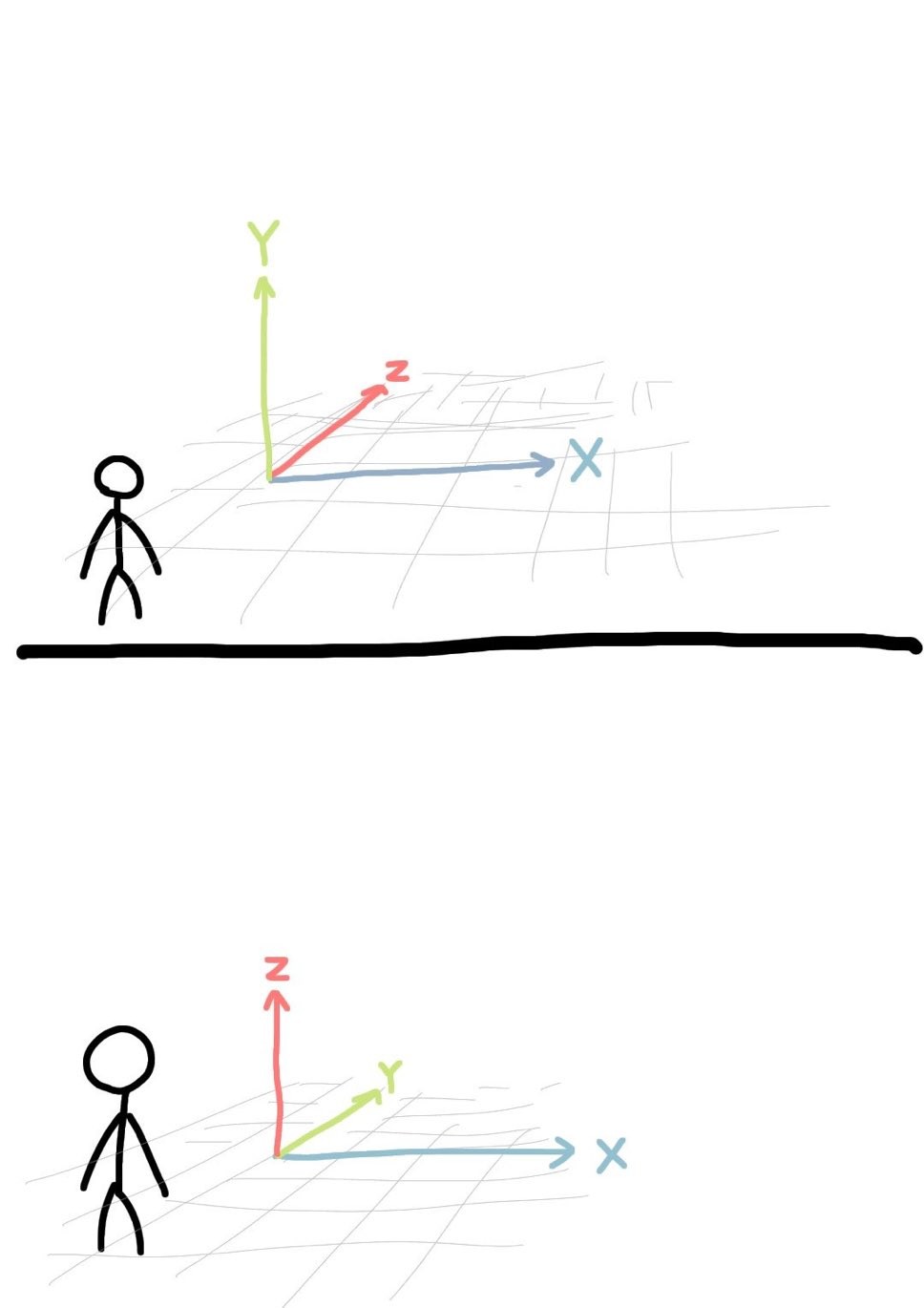

There are people who use the top way? WTF?
Printers
Z is elevation. Any real world application, z goes up down. 3D applications SHOULD use it for elevation. I despise that many do not. It’s so fucking confusing. 2D, sure y go brrr. But once that 3rd dimension is added, y needs to take several seats and quit trying to take on dimensions it doesn’t have any right to.
It makes more sense if you’ve ever drawn in CAD. Top view, x and y. Now side view, y and z or y and x. You look down on x and y, and if you are extruding you now create the z axis dimensions. For the people who draft on the side axis: you are true psychos (ok, unless you’re using a lathe I suppose, or if the silhouette is more defined from the side… ok maybe not psycho, just odd)
User look sideways at item on shelf. Designers look down on paper. Both viewpoints are needed for it to be a good object.
Architects do both because they have all that math and something serious to prove.
You convinced me. Have an internet point.
Z is depth, full stop, and I have my fists raised, Queensbury-style, to anyone who contends otherwise.
deleted by creator
Neither of these are right. X is forward, Y is to the right and Z is down.
Source: https://iansguides.com/tutorials/aircraft-coordinate-system-and-anatomy/
X is up, there now no one is happy.
Above and below the page/plane is the z-axis.
But some people “hold” the page up in front of them, or down on the table.
My “page” is my monitor’s screen, a window into many virtual worlds that extend past the plane of my screen.
Actually, my screen is a curved surface. So the 3d virtual world is projected onto a 2d plane which is then projected back onto a 3d curved screen. The math to make it look correct in the final projection is different from what makes it look correct on a flat screen, though I don’t know if any renderers actually do this correction. Not that I think the difference is huge.
Right handed and left handed? (Top image doesn’t follow right hand rule, Z should point towards camera)
They said “people,” not left handed.
Weird didn’t everyone learn XY on paper on a desk first? All they did was add z axis to that original concept for elevation which gives us the bottom image.
Top image is like if I held paper straight parallel to my face.
didn’t everyone learn XY on paper on a desk first?
No. I was plugging in crazy combinations of r, theta, x, y, z, t, and anything else shown in the built-in demo of that old Mac 3D graphing calculator app years before my teachers got to explaining coordinate systems. I had no idea what most of it meant, but I could make cool looking animated graphics as a third grader…
Also, I found GameMaker which introduced me to using X to the right and Y down in 2D (with the origin in the top-left corner) before algebra was taught to me in school…
When working in 2 dimensions with gravity, it is common to treat Y as up. E.g, 2d video games, physics problems, computer screens.
That’s basically what it comes down to: Is your XY plane a piece of paper that you look at from the top, or is it the pixel coordinates of the screen you are looking through?
That’s why X is usually not contested, because it’s the same on a piece of paper that you view top-down and on a screen that you view from the front.
Y is then one of the two potential axies for either a top-down or a side-scrolling view, and Z is the remaining axis.
Well no. First the teacher drew it on the board, hence Y pointing up at the ceiling.
Then we switched to paper and discovered Y pointing somewhere else was somehow the same thing.
So the right answer to the OP is probably that “they’re the same picture” meme.
ah yes the correct way and the Minecraft way
I clicked on this post to say Y is always elevation because I grew up playing Minecraft.
Getting a 3D printer changed me from the upper to the lower.
No, just no. x is the variable for depth, y is the variable for width, and z is height. I learned that from multivariable calculus, no other convention is better.
Fuck you for showing me this, I’m now going to gauge my eyes out.
How big are you going to gauge them?
No, it’s w, s, j, d.
W for walking, you walk forward.
S for side-stepping.
J for jumping.
And d is for digging because you can’t jump down into the ground.
Technically, there’s a lot more options. Any axis can have any name. The reason why these two main systems exist is because of 2D coordinates.
A 2D coordinate system can either be viewed top-down (piece of paper on a table) or from the front (pixels on a screen). So while X stays the same in both of these options (and thus isn’t contested in 3D coordinates), Y is either up (on a screen) or ahead (on paper), and Z then gets whatever axis is left over.
No, there are 3 actually:

damn Australians
I use all of them depending on what the coordinates are representing…
Z IS UP AND ALSO IT’S BLUE
Why would you represent Z with Y?